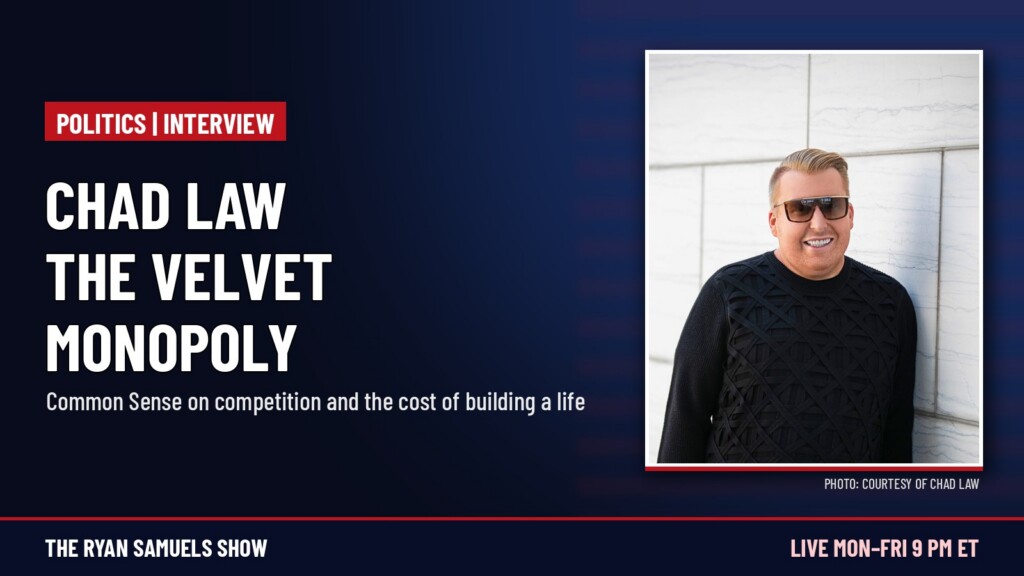
Chad Law was a 4th grader on the couch with pneumonia when he first came across C-SPAN in a family that wasn’t at all political. He went on to do a career in consumer marketing, including work with brands such as L’Oréal and Procter & Gamble amongst others, and then went on to build and sell his own agency. He told Ryan he made that exit at 35 and that he’d been putting that energy into the Tea Party movement and Convention of States Action as a volunteer, and that he’d simply taken that energy and put it into his own show. That show is Common Sense with Chad Law, the independent political commentary podcast which he records every weeknight. He publishes the podcast, the books and the newsletter (The Gaily News) at chadparkerlaw.com.
He was on The Ryan Samuels Show Thursday night (Nov. 19) live at 9 p.m. ET. The thread that runs through his commentary is very simple: politics should be a tool, not an identity.

From a county meeting to a trilogy
Law didn’t set out to write a series. The Cost of Certainty, he said, was the oldest of the three manuscripts and ended up last in print. The first book he actually drove to the end was The Price of Progress: How America Lost Their Seat at the Table, which came about as a result of a county commission meeting in Oregon (where he lives part of the year) on a proposed Google data center.
“This isn’t the government serving people. This is the government selling people,” he said (11:29). To him it was the very essence of a sales pitch he’d been involved in before. “When you go to a public forum, it’s not supposed to be selling, it’s supposed to be listening.” He’s not in any way opposed to data centers. What he absolutely rejected was the idea that the country has to “beat China and destroy all of our rural land holdings at the same time.” The book is his attempt to map the middle ground: how can a community build without losing its place at the table?
The three books came together around July 4, 2026, for the country’s 250th anniversary, and he published them in quick succession as a trilogy. The Velvet Monopoly: How America Quietly Stopped Competing was out on the 8th of July. The Price of Progress followed on the 16th. The Cost of Certainty: How America Confused Knowing with Understanding finished the trilogy later that month.
The Velvet Monopoly and the cost of building a life
Law’s central thesis in The Velvet Monopoly is that we aren’t actually living in a competitive market. The industries that people have no choice but to be in — he calls them the “nine life industries,” including food, medicine, insurance, and housing — have, in his account, been concentrated since the 1980s right down to a very small number of firms between the people who produce the goods and the people who consume them.
“We are not any longer in a cost of living crisis. We’re in a cost of building a life crisis,” he said (13:35). Conservatives, he argued, have abandoned the trust-busting tradition which he sees going back from Theodore Roosevelt and Standard Oil through to Ronald Reagan and the breakup of the Bell System. “Our capitalism has been hijacked,” he said. “There’s no longer any competition in the markets we need it the most.”
He was very careful about the remedy. “I’m not talking about the government picking winners and losers. I don’t want the government to put their thumb on the scale,” he said (19:26). On housing he rejected the notion of a general home shortage. “No, we don’t have a home shortage. We have a starter home shortage. The starter rung of the housing ladder has been completely sawed off.” The small house on a small lot has been regulated out of reach and the way back is to go back slowly and incrementally on the rules rather than go in with a wrecking ball to the big firms.
He used the meatpacking industry as the prime example, citing the PRIME Act, the long-standing bill of Rep. Thomas Massie, which would allow a farmer to take a cow to a local butcher and sell the meat in the same state rather than have every animal go through a USDA-inspected plant. The point he was making was simply more options for the farmer and the consumer, and a lower price as a result of competition rather than a new agency. “The only thing that can lower a price is competition,” he said (26:17).
On health care he said certificate-of-need laws in 35 states and Washington, D.C., have the effect of allowing the existing providers to sit on the boards that decide whether a new clinic or a new scanner is going to be approved. He said independent doctors have all been absorbed into the hospital groups and the pharmacy benefit managers are now sitting across the insurance, the pharmacy and the reimbursement. What he wants is more cash pay and more health savings accounts and less of a system in which, as he put it, anything that insurance touches gets worse and more expensive. Ryan then asked how you unwind the overlap of big business and government without giving the state more power. Law’s answer was the same as in the book: the democratic socialists are often right about the pain and wrong about the cause. “It wasn’t capitalism that did this,” he said. “It was central planning and central control.”
Data centers, AI, and a seat at the table
When it came to AI, Law went back to The Price of Progress. He drew the distinction between the public fight over data centers (which he described as power and water hogs, often located in places with a part-time city council and no full-time paper) and the fight over the technology itself. Americans want to be at the table, and a significant number of the facilities that are the subject of protest are in fact mining cryptocurrency rather than training models.
“I love the data center pushback,” he said (49:31). “I think data centers and Flock cameras are the two things saving America. It’s uniting people together that would have never normally come together.” His concern is that the new Congress will take the local resistance to that as a mandate to go in and tax and license the underlying technology and thereby close the door on the kind of garage-level competition that the commercial internet was left free to produce.
Politics as a tool, not an identity
The harder bit of the job, he says, has been the reaction from his own side. “Something in the last like two to four years, we have really confused intelligence with conviction,” he said (40:03). Every word is now treated as a referendum on your political identity and he’s been labeled a traitor and a liberal by various conservatives for criticizing conservative institutions post midterms. “I’m not anti-regulation, I’m just pro-results.”
He doesn’t pretend the criticism is neutral. Before the midterms, he said, he would write campaign copy on his own show, for free, because he wanted his side to win. “The criticism comes from a place of love,” he said (44:15). If he can’t apply a principle to the people he agrees with, “then it’s not a principle, it’s a vibe.”
On the Republican coalition he went straight for the old image. “I always say Republican Party is a three-headed monster,” he said (59:11). “It’s libertarians who just want to be left alone. It’s Chamber of Commerce Republicans that want cheap labor and low taxes, and it’s the evangelical Christian right that wants everyone in church by Sunday at 10 o’clock. And you have to have two of the three heads happy, or you can’t win.” Heading into this midterm he said all three heads were in a state of misery. The first party that actually delivers a few real things — AI guardrails, less red tape on housing, measures such as the PRIME Act or a fix to the Jones Act — will be the party to hold power for a long time. “They won’t do it,” he added.
What he wants from the media is the same as what he wants from politics. Common Sense with Chad Law is exactly what he describes as mission-based work: conservative principles without just telling people what they want to hear. “We’ve got to make long form content sexy again,” he said (47:49). He was initially against taking the podcast seriously, then decided last January to go all in and build a team as the sole investor. The work doesn’t follow the marketing model that he used to sell perfume. “I can get a 16-year-old to buy $650 perfume on TikTok,” he said (9:01), “but getting people to sit down and listen to long-form content that isn’t salacious or clickbait is, you know, it’s mission-based work.”
About Chad Law
Chad Law is host of Common Sense with Chad Law and author of The Velvet Monopoly, The Price of Progress and The Cost of Certainty. The show, the books, The Gaily News and his Common Sense Conservative Manifesto can all be found at chadparkerlaw.com. Common Sense with Chad Law is on Spotify and you can follow the show on Facebook. The Velvet Monopoly is available on Amazon.
Meet more of Ryan’s guests on the Guests page.