For two election cycles, each party has accused the other of hiding the files. The public record is quite clear in that there has been no cover-up of a secret client list.
By Ryan Samuels
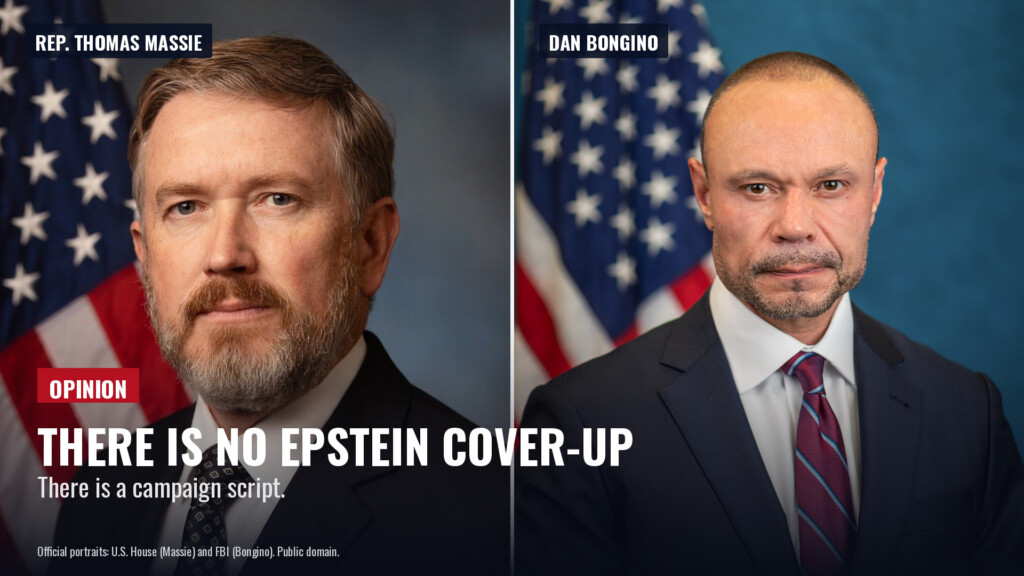
This week, Rep. Thomas Massie, R-Ky., and Dan Bongino were both on X talking about the Epstein files. On Nov. 18, Massie said that Bongino and FBI Director Kash Patel “have defended the suppression of files.” Bongino responded on Nov. 20 that Massie’s comments had “caused a serious security situation for me, my family, and my employees,” and that he had offered a briefing the congressman did not take.
This argument is very loud indeed, but it’s also one we’ve heard before.
For two election cycles, we’ve had the same story from both sides of the aisle, just with the names changed: the other side is hiding the Epstein files. The court record and the government’s own disclosures don’t support the idea of a coordinated government cover-up of a secret client list. What they do show is the very typical Washington mix of bad judgment, delays and campaign opportunism.
During the 2024 campaign, Trump and his team were talking about the new administration going ahead and opening those files. When asked on “Fox & Friends” whether he would declassify the Epstein files, he said, “Yeah, yeah, I would.” The War Room account then posted the clip with the caption that he would “DECLASSIFY the 9/11 Files, JFK Files, and Epstein Files.”
He gave a more guarded answer subsequently. He said he didn’t “know about Epstein so much as I do the others” and that you don’t want to “affect people’s lives if it’s phony stuff in there,” though he would “go a long way toward that one.” In September 2024, he was asked on the Lex Fridman podcast about a “list of clients” and said he would be “inclined” to release the material and would “have no problem with it.”
The message was clear: the government already had those secrets. In January 2024, Pam Bondi, then a Trump ally and later attorney general, told Fox News the documents “should have come out a long time ago.” After taking office, Trump said the Epstein matter “was run by the Biden administration for four years.”
Now let’s look at it from the other side.
This fall, the Democrats made the same claim against the Republicans. Senate Majority PAC released an ad stating that Sen. Dan Sullivan, R-Alaska, had “voted to keep the files hidden from the public.” The Guardian reported that candidates and outside groups spent more than $35 million on Epstein-related ads, including one in which members of Virginia Giuffre’s family said a Republican House candidate “covered up Epstein’s crimes to protect Donald Trump.”
Those ads were all about the earlier procedural battles rather than the final vote. On Sept. 10, 2025, the Senate voted 51-49 to table a Schumer amendment that would have required a release. Two months later, the House passed the Epstein Files Transparency Act 427-1, the Senate passed it by unanimous consent and Trump signed it.
Loads of the midterm ads didn’t have that ending. The ending falls apart if you’re talking about a cover-up that’s been in place for a while.
If you’re looking for a government cover-up, the facts don’t bear that out. Jeffrey Epstein was indicted in the Southern District of New York in 2019, during Trump’s first term. Ghislaine Maxwell was tried and convicted in 2021, during the Biden administration, and received a 20-year sentence. The investigative file was with the department through both administrations. That’s not the behavior of a government trying to bury the case.
The whole campaign was supposed to be about the so-called hidden client list. In February 2025, Bondi was on Fox News talking about that list and said, “It’s sitting on my desk right now to review.” By July, the Justice Department and the FBI had completed their review and said they found “no incriminating ‘client list,’” “no credible evidence” that Epstein blackmailed high-profile people, and no evidence “that could predicate an investigation against uncharged third parties.”
Bongino, who was the FBI’s deputy director at the time, said he had “reviewed the case” and that Epstein took his own life, with “no evidence in the case file indicating otherwise.” After leaving the bureau in January 2026, he said, “What we thought was going to be in there wasn’t in there.”
Epstein’s death has often been referred to as the smoking gun in the cover-up. The New York City medical examiner, the Justice Department’s inspector general in June 2023 and the July 2025 joint review all found it to be a suicide. The inspector general’s report documented serious Bureau of Prisons failures — missed counts and rounds — which is a case of negligence, not evidence that he was murdered.
Then the documents started to come out. In January 2024, Judge Loretta A. Preska began unsealing discovery in Giuffre v. Maxwell. Being named in those documents is not a crime. The Justice Department missed the 30-day deadline after the transparency law passed, but on Jan. 30, 2026, it announced it had published nearly 3.5 million pages. Federal judges in Florida and New York also unsealed grand jury materials, with redactions to protect victims.
A Republican-led House Oversight Committee report released Nov. 10 found no documents in estate, bank or Justice Department records that linked the president to Epstein’s or Maxwell’s crimes. It did, however, criticize the years of federal failure.
In 2008, federal prosecutors in Southern Florida entered into a non-prosecution agreement whereby Epstein would avoid a federal indictment in exchange for a state plea. In 2019, U.S. District Judge Kenneth A. Marra held that prosecutors violated the Crime Victims’ Rights Act by failing to confer with the victims first. That was a genuine legal violation and a clear failure of judgment, but it is not evidence of a conspiracy to hide a client list that later reviews said they did not find.
The same is true of the current disputes. Massie and his co-sponsors say the Justice Department is still unlawfully holding back more than 3 million files. The department says it released what the statute required and withheld material under legal exceptions, including victim protection. The Oversight report found the redactions to be very poor and recommended that the department re-interview witnesses and look further at certain associates.
The primary reason the release is taking so long isn’t because of a hidden client list. It’s the work of the law to ensure the victims aren’t identified.
The Epstein Files Transparency Act allows the Justice Department to withhold or redact “personally identifiable information of victims” and similar files whose disclosure would constitute “a clearly unwarranted invasion of personal privacy.” Reviewers have to go through the millions of pages, one page at a time. In a Dec. 19, 2025, letter to Congress, issued on the statutory deadline, the department said final review was still underway “because of the volume of the material and the requirement that every page of every document be reviewed for potential redactions under the Act.” A federal judge in New York had also added another layer of review “to minimize the risk of inadvertent production of protected victim information.”
A New York unsealing order permitted the release of grand jury material “subject to redactions of all personally identifying information and other information required to be redacted by law.” When the department released the millions of pages, the Oversight Committee found that the deficient redactions “exposed sensitive information of survivors” and asked the department to fix those redactions. I don’t need to pretend that process was clean. The delay appears to be the result of a privacy-review bottleneck.
These are debates about the rules and the work which hasn’t even been done. They’re not in any way evidence of a coordinated cover-up. Survivor identities must be protected. Privacy should not be a tool for the powerful.
I can’t open a sealed filing just by watching a campaign ad. I can read the public record, though, and it doesn’t show the cover-up both sides have claimed.
The files that did come through were via indictments, verdicts, court orders, an inspector general, a statute and a multimillion-page release. The promised client list didn’t appear at all.
That’s not a cover-up. That’s exactly what the record shows.
Featured image: Official portraits: U.S. House / Wikimedia Commons (Massie) and Federal Bureau of Investigation / Wikimedia Commons (Bongino). Public domain.