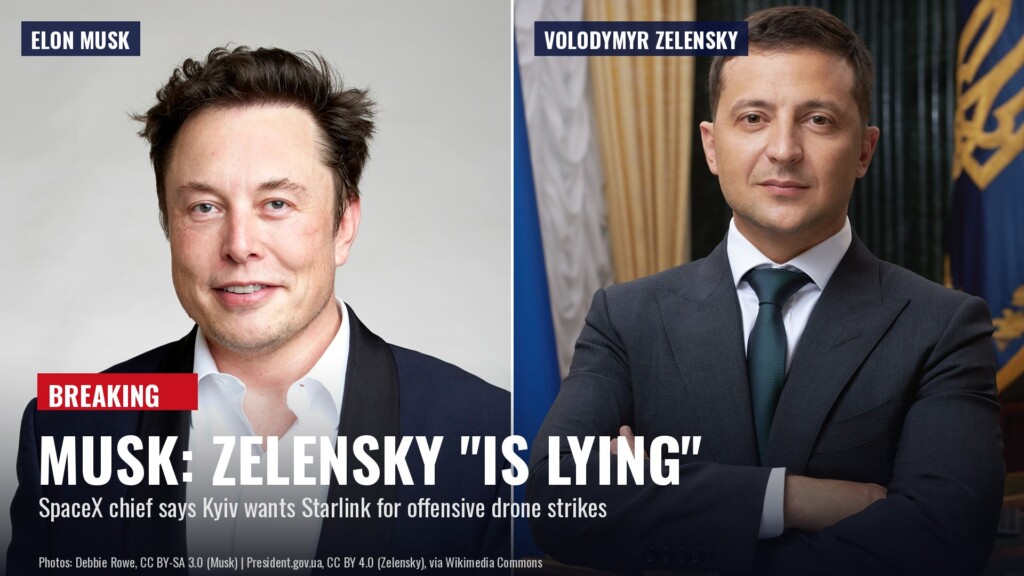
Elon Musk said out loud on Wednesday what he has been writing on X for a month. Sitting across from Andrew Ross Sorkin at the DealBook Summit in New York on November 18, he said Volodymyr Zelensky is not telling the truth about Starshield, and that what Ukraine really wants is to use Starlink, a commercial service, for offensive military strikes. Sorkin pressed him. Was Zelensky not using Starshield, or was he lying? “He is lying,” Musk said. “What he is actually saying is he wants to use Starlink for offensive military operations.”
I have watched this fight build since October, and I think most of the coverage misses the one distinction that matters. There are two systems here, not one. Starlink is the civilian satellite internet that SpaceX sells to farmers, schools and ships. Starshield is the military-grade version built for government customers, and Musk says the United States government owns and controls it. Musk has drawn that line from the start. “Do not ask me as a private individual to make kill decisions,” he told the audience. If Kyiv wants to run offensive missions over the network, he said, “it needs to be the Starshield system where the kill decision is that of the War Department, perhaps ultimately the president, and not mine.”
That is the heart of it, and I agree with him. A private citizen who owns a satellite company should not be the man who decides which drone flies into which target. That power belongs to elected leaders and the officers who answer to them. When we hand those choices to a CEO, we blur the line between commerce and war, and we blur accountability with it.
Here is how we got here. In mid-October, Ukrainian officials said terminals on fast-moving drones had started dropping off the network. A Ukrainian defense official said the receivers worked again, but only up to about 100 miles per hour. On October 14, Ukraine’s digital minister, Mykhailo Fedorov, thanked Musk on X for restoring service at speeds up to 160 kilometers per hour and asked him to lift the Starshield cap entirely. Musk answered him the same day. “Starshield systems are owned and controlled by the US government,” he wrote. “Any limits on speed or usage are decided by the US military and ultimately POTUS.”
Ten days later, Musk went further. On October 24 he wrote that “Ukraine military violated Starlink terms of service and used it for offensive drone strikes to kill people. That loophole was closed last week.” In the same post he called Starlink “critical to the defense of Ukraine” and said the front line would collapse without it. “This is NOT a threat,” he wrote, “it is simply a statement of fact.” The next day he added that Zelensky himself had posted about using Starlink for offensive drone strikes.
Ukraine tells a different story, and fairness requires me to lay it out. Ukrainian officials disputed the claim that they misused Starlink. One official told reporters that existing restrictions made such strikes on Russian territory “physically impossible.” On November 13, Zelensky said in his nightly address that “the speed restrictions remain in place along the entire front line and in temporarily-occupied territories of Ukraine.” On November 14 he told reporters that SpaceX had said there were no restrictions and blamed technical problems. “We do not believe that is the case,” he said. Then on Wednesday, the same day Musk took the stage, he said the limits were still hurting Ukraine’s ability to stop Russian missiles and drones. “We are discussing this with the American side,” he said.
The reporting on who gave the order does not settle it either. Reuters, citing two U.S. officials and a Western official, reported on October 16 that the order to slow Starshield came from inside the White House. The Wall Street Journal later reported, citing U.S. officials and people familiar with the matter, that Musk himself had ordered the slowdown. Those two accounts cannot both be the whole truth, and nobody has put the full record on the table.
So where do I come down? I come down on the principle. Musk has said the same thing for a month in public and on the record: Starlink is for civilian and defensive use, and offensive action runs through Starshield and the Pentagon. That is a clear rule, and a company has every right to enforce the terms of its own product. If Ukraine needs a system that can guide strike drones at full speed, that request belongs with the War Department and the White House, not with a private company in Texas.
I also think Washington owes the public a straight answer. If the United States government owns and controls Starshield in Ukraine, then the United States government can say who set the speed limit and why. The Pentagon, the White House and SpaceX should clear this up in writing. Our allies deserve that clarity, and so do the American taxpayers who pay for the Pentagon’s Starshield contracts.
What I will not do is pretend this is a simple story of a villain and a victim. Musk wrote in October that Starlink was crucial in the early days of the war, when Russia destroyed or jammed all other means of communication. I believe him. Zelensky is fighting for his country’s survival, and I understand why he wants every tool he can get. But wanting a tool does not change the rules that come with it. Musk drew a line between selling a service and waging a war. I think that line is the right one, and I hope our government has the courage to own its side of it.
I host The Ryan Samuels Show, live weeknights at 9 PM ET.