A 41-year-old trainee at the BioUrja Renewables plant now faces federal explosives threat charges after a device forced thousands from their homes in Peoria and East Peoria. He pleaded not guilty. I’m asking the security questions nobody in charge wants to answer.
By Ryan Samuels
On the evening of April 17, 2013, a fire broke out inside the West Fertilizer Co. plant in West, Texas. About 22 minutes later, the ammonium nitrate stored there exploded. Fifteen people died, 12 of them first responders, and the blast destroyed more than 500 homes. Three years later, the ATF ruled that someone set that fire on purpose. As of the ATF’s 10-year reward notice in 2023, no one had been charged. West is where I want to start, because of what nearly happened in Peoria, Illinois, last Friday.
That afternoon, crews found an explosive device at the BioUrja Renewables ethanol plant, which sits right in the middle of the city. Police ordered a one-mile evacuation that reached into downtown Peoria, East Peoria, and the Warehouse District, and thousands of people left their homes and businesses because someone had put a bomb at a facility full of highly flammable ethanol and chemicals. On Tuesday, a federal grand jury indicted the man authorities say is responsible. Andrew M. Kozak is 41 and lives in Chillicothe, and the U.S. attorney says he works at the plant as a trainee. He pleaded not guilty. The law presumes him innocent, and so will I, until the government proves its case in court.
The charges themselves deserve a careful reading. According to the U.S. Attorney’s Office, count one accuses Kozak of using email to threaten to destroy a building “by means of fire and an explosive,” and count two accuses him of emailing BioUrja that someone had placed explosive devices at the facility. Those counts carry maximums of 10 years and five years. Both rest on what he allegedly said. As CBS Chicago pointed out, the indictment does not accuse him of planting the bomb. Federal law draws that line deliberately. The threat statute, 18 U.S.C. § 844(e), punishes the words. A separate subsection, 844(i), covers anyone who damages or attempts to damage commercial property with fire or an explosive, and it carries a five-year minimum and a 20-year maximum. Prosecutors have not charged that offense. ABC News reported Tuesday night that more charges are possible.

BioUrja reported the threat around 1 p.m. Friday, according to FOX 32 Chicago, and about an hour later crews found a suspicious package on the grounds. By evening, police had judged it credible, and bomb technicians rendered it safe that night while the Coast Guard held barge traffic on that stretch of the Illinois River. ABC described the plant as larger than 44 football fields, and it stores ethanol along with other highly combustible chemicals. Peoria Police Chief Brad Dixon told WCBU that police evacuated about 2,500 homes, and the order held for roughly 18 hours. No one was hurt. Mayor Rita Ali told the station, “We didn’t dodge a bullet. We dodged a bomb.”
We got lucky. Luck, though, makes a poor security plan, and the details that followed should trouble anyone who lives near a plant like this one. Federal law enforcement sources told NBC Chicago that agents arrested Kozak Monday morning when he showed up for work. His LinkedIn profile lists him as a process trainee at BioUrja since February, “learning how to operate an ethanol plant,” and describes him as “proficient in running chemical plant operations.” NBC Chicago and the Associated Press both report that Nebraska records show prior burglary convictions and time in prison.
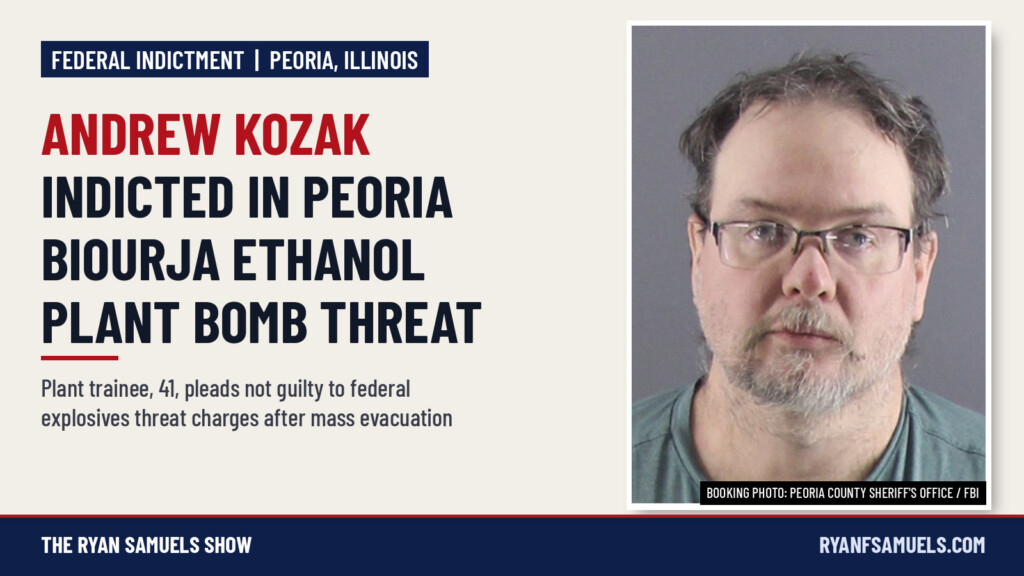
When I put his booking photo on screen during the show, the first thing I noticed was how ordinary he looks. You could pass him in a parking lot and never look twice. Vetting exists because appearances tell you almost nothing.
So I’ll ask the question I asked on air. How does a man with that record end up with access to a site packed with ethanol and other combustible chemicals? I believe in second chances, and many people who served their time earn one. A fuel plant in the middle of a city still calls for a higher standard than most workplaces, and I’d like to know how many people with similar histories work inside chemical plants, refineries, and power stations across this country.
The federal safeguards have grown thinner since 2023, and the chemical industry has said so itself. For 16 years, the Chemical Facility Anti-Terrorism Standards program let high-risk chemical sites screen workers against the federal terrorist database. Congress let its authority expire on July 28, 2023, and CISA says that leaves roughly 9,000 names unchecked each month. I don’t know whether BioUrja ever fell under that program, and a terrorist-watchlist check would not have flagged a burglary record from Nebraska in any case. Criminal-history screening at fuel and chemical sites falls to the companies that own them, and after Friday, every one of them should be reviewing its own.
The part I still can’t square is the warning. If the government’s theory holds, someone planted a working device, emailed the company that it was there, and then reported for his next shift. A person who truly wants a bomb to go off doesn’t announce it. Maybe he never meant it to detonate. Maybe the motive was money, or a grudge, or something no one has disclosed. The indictment names no motive, and U.S. Attorney Gregory Gilmore declined to say how agents identified Kozak so quickly. ABC reported that the device went to an FBI lab in Alabama and that investigators are still working to learn whether he acted alone. The FBI is leading the investigation, as it should.
Peoria also landed in a hard week. The FAA grounded the country, two major banks lost their apps, and the FBI warned that an AI tool can seize networks in under three hours. Officials have called those outages technical failures, and I have seen no evidence otherwise. What happened at BioUrja belongs to an older category of risk, a physical device allegedly placed by someone with a badge, and Peoria had to empty its own streets to deal with it.
Kozak’s detention hearing is Friday at 11 a.m., and the court has set trial for Jan. 11. I don’t like writing about a case this early, and I’ve been wrong before. My instinct is that this story fades once the cameras leave, maybe into a quiet plea. I intend to keep reporting on it as the evidence comes out.
Tell me what you think. Watch the full breakdown above, and catch The Ryan Samuels Show live Monday through Friday at 9 PM ET.
Listen to The Ryan Samuels Show:
YouTube: https://www.youtube.com/@RyanFSamuels
Apple Podcasts: https://podcasts.apple.com/us/podcast/the-ryan-samuels-show/id1652595335
Spotify: The Ryan Samuels Show on Spotify
Rumble: https://rumble.com/c/TheRyanSamuelsShow
Featured image: booking photo of Andrew M. Kozak, Peoria County Sheriff’s Office / FBI, as published by 25News Now (WEEK). Text added.