
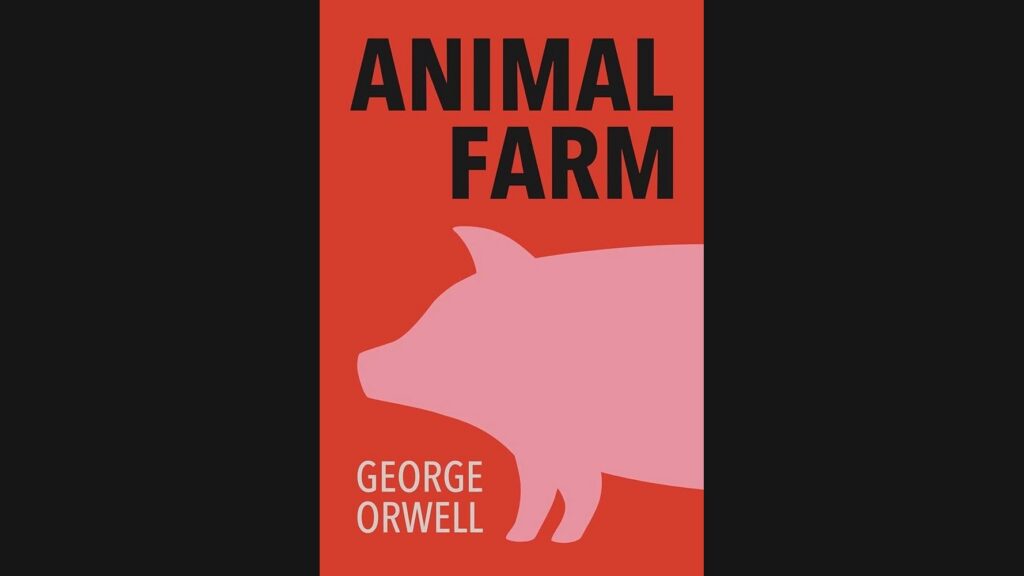
Animal Farm, published in England on August 17, 1945, is George Orwell’s fable of a revolution that replaces one set of masters with another. The animals drive Farmer Jones from Manor Farm, paint seven commandments on the barn wall, and then watch the pigs revise every commandment until only a single joke remains: “All animals are equal, but some animals are more equal than others.”
Orwell was writing about the Russian Revolution and Stalin’s hijacking of it. The book survives because the method travels. A ruling group changes the past, monopolizes the language, rewards the loyal, works the credulous to death, and still calls the result equality.
What happens on the farm
Old Major, the prize boar, dies after preaching a dream of animals freed from human theft. The speech is Marx and a touch of Lenin, delivered in a barn. Snowball and Napoleon lead the uprising. Jones is expelled. The farm is renamed. For a little while the place works, because stolen labor has been replaced by shared labor and because the enemy is still obvious.
Then the story turns, as these stories do, on who keeps the milk and apples. The pigs reserve them. Snowball, the closer cousin to Trotsky, wants a windmill and a wider revolution. Napoleon, Stalin in porcine form, has him chased off the farm by raised dogs the other animals did not know he was training. The windmill becomes Napoleon’s idea after all. The neighboring farmers, once the embodiment of evil, become dinner companions.
Squealer does the explaining. Orwell says he could “turn black into white.” When the commandment “No animal shall sleep in a bed” becomes “No animal shall sleep in a bed with sheets,” Squealer is ready with a tutorial on why the animals misremembered the original paint. The same trick revises the ban on drink and the ban on killing other animals. Boxer, the cart-horse whose answer to every hardship is “I will work harder,” collapses and is sold to the knacker. The pigs throw a banquet and explain that he died in comfort. By the last chapter the pigs are walking on two legs, wearing clothes, and playing cards with the humans. The other animals, watching through a window, can no longer tell the species apart.
That plot is short on purpose. Orwell wanted no reader to get lost. The Soviet originals are easy to map: the show trials, the erased comrades, Pravda’s flexible truth, the starving countryside, the new elite that hunts like the old one. If you want the nonfiction inventory of the same system, read the site’s essay on The Gulag Archipelago. If you want the fully developed nightmare of language as a weapon, read 1984.
Why the barn wall still matters
The most modern thing in Animal Farm is not the secret police dogs. It is the paint. Power prefers not to admit that it has changed the rules. It prefers to tell you the rules were always what they are today, and that your memory is the problem.
Watch for that habit. Officials redefine words such as “violence,” “woman,” “disinformation,” or “infrastructure,” then treat dissent as a reading-comprehension error. Platforms and bureaucracies adjust the historical record in real time, burying statements that have become inconvenient. School materials skip the parts of American history that complicate a preferred story, or they flatten the whole country into a single original sin and call the flattening honesty. The technique is Squealer’s: do not defend the revision, deny that a revision occurred.
The second lesson is about unearned equality. The animals wanted relief from a real injustice. Jones was a bad farmer, and revolutions do not start from nowhere. What they got was a new hierarchy that spoke the language of the old rebellion while living on the old luxuries. A politics that begins with “for the workers” or “for democracy” or “for equity” and ends with an exempt class is following Orwell’s outline, not violating it. The pigs did not abandon the revolution’s vocabulary. They fed on it.
The third lesson is Boxer. Societies fail not only because Napoleons are ambitious, but because decent people outsource their judgment. Boxer is loyal, strong, and incurious. Those qualities make him admirable in a neighbor and fatal in a citizen. “Napoleon is always right” is funny on the page. It is less funny when voters, employees, or congregants repeat a leader’s last statement and forget his first one.
None of this requires pretending that the United States is Animal Farm. It isn’t. We still have elections, courts, a First Amendment, and the chance to throw a faction out. Orwell’s warning to a free country is that those tools rust when people stop using them, and that propaganda works best on an exhausted public that would rather be told what it just saw.
A short book that asks for a long memory
Animal Farm is usually well under 150 pages. High-school students meet it and think they have finished with it. They haven’t. The test Orwell sets is whether you can recognize a rewritten commandment when it appears in a press conference or a corporate memo rather than on a barn.
Constitutional government is, among other things, an attempt to nail the commandments down. Written laws, enumerated powers, and a press the government does not own are ways of keeping Napoleon away from the paint. Hayek made the economic version of the point in The Road to Serfdom: centralize enough authority and the people who enjoy commanding will find you. Orwell made it vivid. A child can follow the story. An adult has no excuse for missing the application.
Read the thing again. Notice how early the pigs take the milk. Notice how late the other animals admit what they are looking at through the dining-room window. The distance between those two moments is where republics are lost.
Golding made a close cousin of the same warning in Lord of the Flies. The political version, without the barn, is in Marxist infiltration into American society.
The Ryan Samuels Show is live weeknights at 9 PM ET. The podcast is at pod.link/1652595335.
Sources
- George Orwell, Animal Farm (Secker and Warburg, London, August 17, 1945), including the revised commandments and the “more equal than others” maxim
- Orwell’s preface materials and his stated target: the Soviet myth as received in wartime Britain
- Companion discussions on this site: 1984, The Gulag Archipelago, and Friedrich Hayek’s The Road to Serfdom