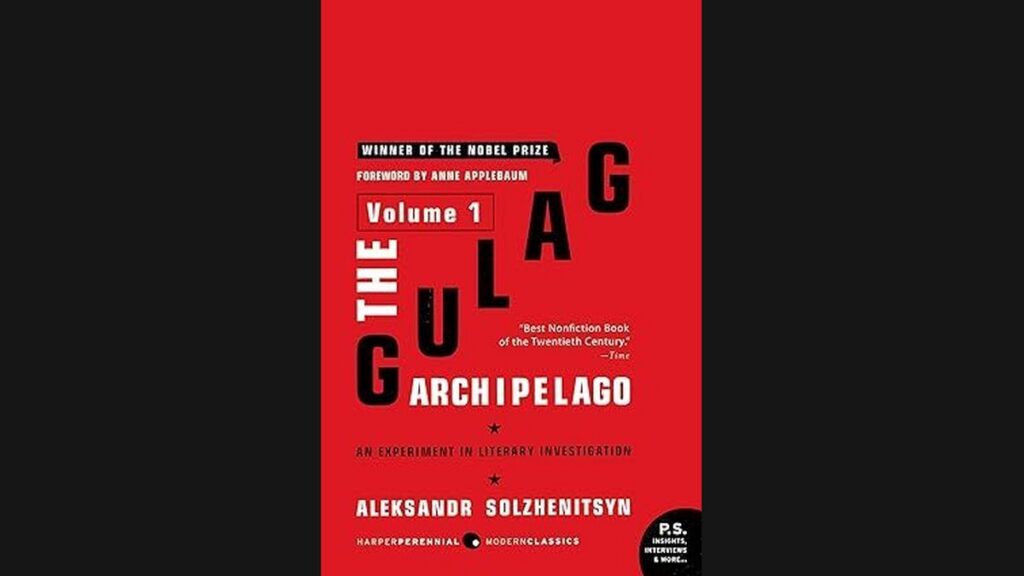
The Gulag Archipelago is Aleksandr Solzhenitsyn’s account of the Soviet labor camps, drawn from his own imprisonment and 227 other witnesses. Published in Paris on December 28, 1973, after the KGB seized a hidden copy, it did what armies and communiqués had failed to do: it made the lie too large to ignore.
America is not the USSR. Anyone who says otherwise is doing the book a disservice. The reason to read Solzhenitsyn now is narrower and harder. He showed how a modern state trains ordinary people to live inside a lie, to inform on their neighbors, and to call that arrangement justice. Those habits do not require a frozen camp in Kolyma to do damage.
A prisoner who refused to forget
Solzhenitsyn was arrested in 1945 for criticizing Stalin in letters from the front. He was a decorated artillery captain. That did not matter. The sentence was eight years in the corrective-labor camps. He survived, taught, wrote in secret, and won the Nobel Prize in Literature in 1970, which the Soviet authorities treated as an insult rather than an honor.
The Gulag Archipelago is not a novel, though it has the moral voltage of one. Solzhenitsyn called it an experiment in literary investigation. He reconstructed arrests at night, the ritual of the search, the conveyor of interrogations, the packed cattle cars, the mines and logging sites, the informers planted among the prisoners, and the ideological language that made all of it sound like hygiene. “This book contains no fictitious persons, nor fictitious events,” he wrote. It rests on those 227 reports, memoirs, and letters, plus his own memory.
When the secret police confiscated a manuscript in August 1973, he authorized publication abroad. The YMCA-Press edition appeared in Paris that December. Moscow answered with a campaign of slander, then with force. On February 12, 1974, he was arrested. That same day his essay “Live Not by Lies” began to circulate. On February 13 he was stripped of citizenship and put on a plane to West Germany.
He had already given readers the line that explains the rest of the work. The line separating good and evil, he wrote, “passes not through states, nor between classes, nor between political parties either—but right through every human heart.” That is not a greeting-card consolation. It is an accusation aimed at the reader. The camps were built by ideologues, and they were staffed by people who told themselves they were only doing their jobs.
How a lie becomes a government
The machinery Solzhenitsyn describes has a familiar sequence. First comes the theory that history has a scientifically approved direction. Then comes the category of people who stand in the way: kulaks, wreckers, cosmopolitans, whatever word is in season. Then comes the midnight knock, because a regime that believes it embodies History cannot afford a real trial. Then come the statistics, which always improve, and the newspapers, which always agree.
Language does a lot of the work. A prison camp becomes a “corrective” institution. A forced confession becomes “rehabilitation.” An execution becomes a social necessity. George Orwell mapped the same disease in fiction; Solzhenitsyn footnoted it with corpses. Read them together: Animal Farm and 1984 describe the method, and The Gulag Archipelago enters the names.
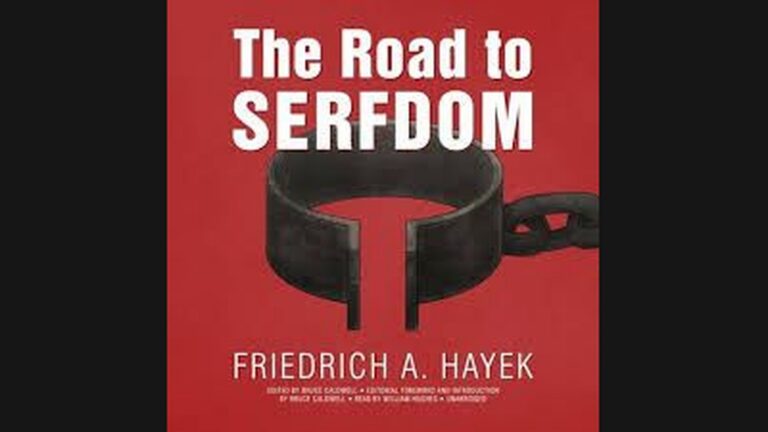
Friedrich Hayek warned that central planning concentrates power until it cannot tolerate dissent. His argument sits one shelf over, in the site’s review of The Road to Serfdom. Solzhenitsyn supplies what Hayek, writing earlier and farther from the camps, could only foresee: the human inventory of a fully planned moral life.
The Soviet Union is gone. The temptation to treat politics as a substitute religion is not. You can hear it whenever a public institution decides that disagreement is harm, that speech is violence, and that the remedy is to make the speaker unemployable. No, a human-resources investigation is not the NKVD. Yes, the spiritual move is recognizable: replace argument with a verdict about the other person’s essence, then invite everyone nearby to join the verdict or join the accused.
“Live not by lies”
Solzhenitsyn’s instruction to his countrymen was almost embarrassingly practical. He did not tell them to storm the Kremlin. He told them to stop repeating what they knew to be false. Do not vote for a sham. Do not copy a prescribed slogan. Do not sign a letter you do not believe. Do not let your children recite the approved untruth at school just to keep the peace.
That is a citizen’s program, and it travels. A free country can lose its nerve long before it loses its courts. People begin to write emails they do not mean. Professors skip the paragraph that would get them reported. Companies issue statements about subjects they do not understand, because silence has been redefined as guilt. Each act is small. The sum is a culture in which truth becomes a private hobby.
The American answer to that pressure is not a strongman who will impose “our” narrative instead. It is the older American answer: a First Amendment that assumes adults can hear error, a Constitution that keeps any one faction from owning the coercive machinery, and enough personal courage to say what is in front of one’s eyes. The camps began with a party that claimed the right to rewrite reality. They were maintained by millions who found it safer to nod.
Solzhenitsyn later unsettled some of his Western admirers by criticizing our vulgarity and our spiritual thinness. He was not applying for a job in anyone’s coalition. He had earned the right to tell comfortable people that liberty without a conscience becomes another form of appetite. A Catholic reader will recognize the anthropology. Man is not raw material for the state. He has a soul, and any system that denies that fact will end by processing him.
The book is long. Read it anyway, or read a careful abridgment and then go back for the rest. Let the inventories of the dead slow you down. Then ask the only question that justifies the time: where, in your own ordinary life, are you being asked to repeat something you do not believe?
Solzhenitsyn’s warning was never that the secret police might appear on your street tomorrow. It was that you might help them, in small ways, if you ever decided that truth was optional.
The ideology did not stay in the archives; see Marxist infiltration into American society. A family that fled the system he described is in Fled the Soviet System. California Removed Their Daughter.
The Ryan Samuels Show is live weeknights at 9 PM ET. Listen at pod.link/1652595335.
Sources
- Aleksandr Solzhenitsyn, The Gulag Archipelago, 1918–1956 (YMCA-Press, Paris, December 28, 1973); author’s note on 227 witnesses
- Solzhenitsyn Center timeline (arrest, Nobel Prize, publication, expulsion): https://www.solzhenitsyncenter.org/timeline
- “Live Not by Lies,” February 12, 1974: https://www.solzhenitsyncenter.org/live-not-by-lies
- New York Times, “Solzhenitsyn Exiled to West Germany And Stripped of His Soviet Citizenship,” February 14, 1974: https://www.nytimes.com/1974/02/14/archives/solzhenitsyn-exiled-to-west-germany-and-stripped-of-his-soviet.html
- Nobel Prize in Literature, 1970, awarded to Aleksandr Solzhenitsyn