A Texas public university had a man arrested for trespassing after he’d been talking to students on its plaza. Whatever the statute says, the Constitution has the final word.
By Ryan Samuels
On Nov. 18, T. Russell Hunter was standing on an outdoor plaza at the University of Texas at Dallas, talking to students. He left in handcuffs. If that doesn’t bother you, you’ve forgotten who a state university is supposed to be working for.
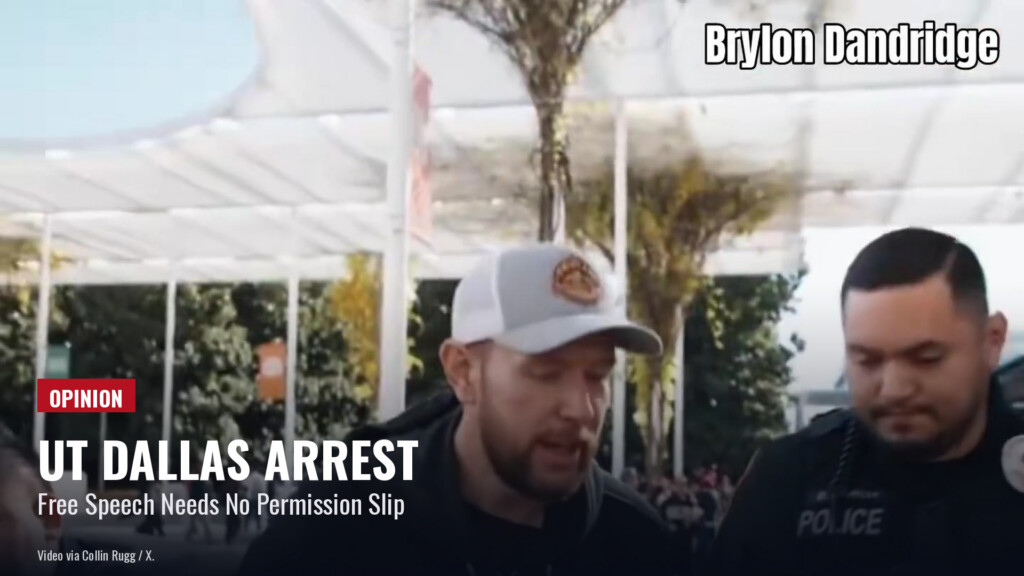
The video that spread this story came from Collin Rugg’s post on Saturday. It shows Hunter, founder of Abolitionists Rising, being told to leave and then being arrested.
Abolitionists Rising says Hunter was arrested Wednesday, Nov. 18, after two and a half hours of conversation, and says he was released Thursday. His attorney, C.J. Grisham, says the charge is criminal trespass. The university police crime log does list a criminal trespass at the “Mall Area” at 1:46 p.m. that day, “Cleared By Arrest.” That’s consistent with the timing and location, though the entry doesn’t name anyone. I found no university statement. Hunter is charged, not convicted.
On the video, a UTD administrator, whom Abolitionists Rising identified as associate dean Tricia Losavio, says, “Unfortunately, you guys aren’t allowed to be here. We’re not an open campus anymore.” She adds, “You have to be affiliated with a student organization.” A student then asks, “Please, can you please let him stay?” The response: “No, sir. He has to leave.” Then the crucial bit: “I’ve had several students complain about what was being shown.”
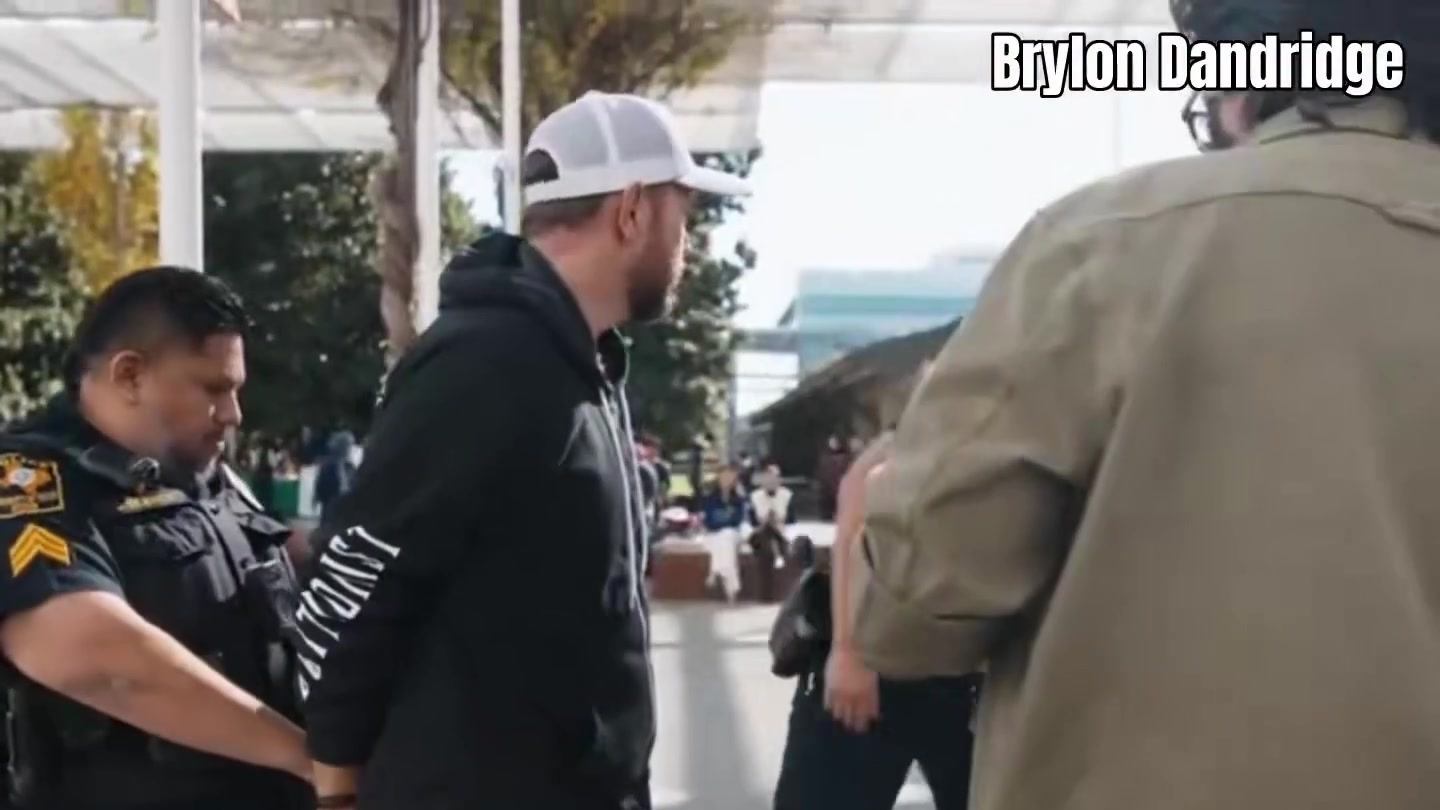
Asked what law he was breaking, Hunter gets one response from an officer: “Criminal trespass.” Hunter says he’d been having a “super civil conversation for the last hour.” There’s no amplifier in the footage, and Grisham says there was no bullhorn. The signs shown were a historical slave-auction illustration and a picture of a fetus. Many will find that hard to look at. The solution is to look away. Arrest isn’t.
The heckler’s veto. When officials get rid of a speaker because the audience objects to his message, the objectors win just by complaining. The Supreme Court has been clear that the audience’s reaction to speech is not a content-neutral ground for regulation. In Bible Believers v. Wayne County, the full Sixth Circuit held that officers are there to manage a hostile crowd, not to silence the peaceful speaker. There was no hostile crowd here. On the video, a student simply wanted Hunter to stay. UTD’s best argument is that this was a matter of status rather than message: he wasn’t affiliated, and UTD’s rules don’t permit the public to be there. That is a legitimate argument, but an administrator citing complaints about “what was being shown” gives a court the other reading.
What I believe. Our rights don’t come from a university, a legislature or a dean. The Declaration says men are “endowed by their Creator with certain unalienable rights.” They exist before government, and government is instituted to secure them. A public university is government. When it tells a man who is peaceably speaking that his speech needs a sponsor or an affiliation, it is treating a right as a privilege it can bestow. Jefferson wrote that his University of Virginia “will be based on the illimitable freedom of the human mind” because “we are not afraid to follow truth wherever it may lead.”
What the law says. In 2019, SB 18 made common outdoor areas traditional public forums open to “any person.” In 2025, SB 2972 limited that to “students enrolled at and employees of” the institution, removed the public-forum requirement and put the onus on governing boards to designate forums. UTD’s policy says no areas have been designated, and its Dean of Students brief says unaffiliated members of the public “are not permitted to participate in assemblies on campus at this time.” The policy does, however, allow the public to reserve outdoor space.
Hunter’s side has pointed to the federal injunction in FOCUS v. Eltife. That injunction blocks the overnight ban and the end-of-term rules, including at UT Dallas, but Grisham says it covers different provisions. It doesn’t touch the students-only rule. And the overnight and end-of-term rules weren’t in play anyway. The arrest came in the middle of the afternoon, and fall classes run through Dec. 9. Under the statute as written, Hunter’s statutory claim looks weak. I won’t pretend otherwise.
The statute is the wrong question. A legislature cannot shrink the Constitution, and SB 2972 says so itself: nothing in the section may be construed to limit a person’s First Amendment rights. In Healy v. James, the Court held that a state college could not deny recognition to a student group because of its philosophy or an unsupported fear of disruption. In Widmar v. Vincent, the Court held that a university that opens its facilities may not exclude speech by content without a compelling reason. Both involved student groups, and UTD will say a stranger is different. The principle is the same, though: the state must justify the exclusion, and “someone complained” is not a sufficient justification. Whether this plaza is open in practice is a forum question. On the video, Hunter says, “people do this on this university every week.” That’s a question for the courts.
Hunter is charged and is entitled to the presumption of innocence and a fair day in court. UTD is entitled to explain why it acted, and I hope it does. A public university should be able to give a ready answer to one question: who gave you the authority to decide this speech was too much?