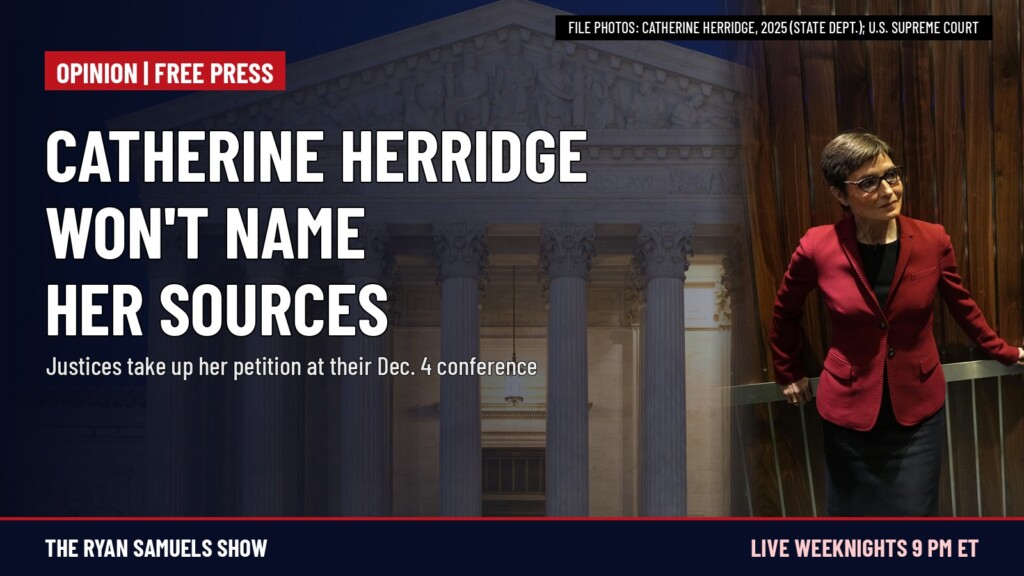
A federal judge held the veteran national security reporter in contempt for refusing to name the sources behind her reporting on a woman’s alleged ties to China’s military. The justices meet Dec. 4 to decide whether to hear her appeal.
By Ryan Samuels

I said something on my show Tuesday night that I meant as a passing comment. I have connections and sources everywhere. People tell me things. Sometimes they tell me things off the record, which I’ll never disclose. Sometimes they tell me things on the record, and I still don’t disclose them, because I don’t need to. I use those sources to understand what’s really going on.
Every reporter worth reading works that way. That’s why the case of Catherine Herridge should worry anyone who has ever passed along a tip, received one, or read a story that started with one.
In 2017, while at Fox News, Herridge reported on Yanping Chen, the founder of the University of Management and Technology in Arlington, Virginia. The school enrolled American service members on Pentagon tuition assistance. Herridge’s stories raised questions about whether Chen had served in China’s People’s Liberation Army and whether she hid that service on immigration forms. The FBI investigated Chen. Prosecutors never charged her. After a national security review, the Pentagon cut off the school’s tuition assistance, according to Herridge’s filing.
Chen never sued Herridge for defamation. No one disputes the facts Herridge reported. Chen sued the federal government instead, under the Privacy Act, claiming officials leaked her records. To prove it, she wants Herridge to name her sources. A federal judge ordered Herridge to do it. When she refused, Judge Christopher Cooper held her in civil contempt and fined her $800 a day. The D.C. Circuit upheld the order, and it denied rehearing in May. In August, Cooper put the fines on hold until the Supreme Court finishes with the case, and he ordered any payments returned.
On Nov. 17, her lawyers, led by Paul Clement, filed their final reply brief. The same day, the Court set the petition, No. 26-461, for its Dec. 4 conference. Nothing has been decided yet. The justices can grant review, deny it, or hold it.
I start from first principles. As I said on the show when Minnesota charged James O’Keefe, the freedom of the press is an individual right. It’s not CNN. It is you. It is your right as a human being, the same as your speech. You’re allowed to collect information, report it, and talk about what you found. The First Amendment didn’t create that right. It recognized one we already had, from God and from our nature as people who think and speak. Government exists to secure it, not to ration it.
Jefferson understood this. In 1787, he wrote to Edward Carrington that if it were left to him “to decide whether we should have a government without newspapers, or newspapers without a government, I should not hesitate a moment to prefer the latter.” His letter tied that liberty to the people’s right to “full information of their affairs.”
You can’t gather that information without sources. A right to publish means little if a court can force you to hand over the person who told you the truth. A whistleblower inside the FBI or the Pentagon won’t pick up the phone if he thinks any civil plaintiff can unmask him.
The Supreme Court last took up the reporter’s privilege in Branzburg v. Hayes, a 5-4 grand jury case from 1972. Since then, the appeals courts have split. The Seventh Circuit has said “there isn’t … a reporter’s privilege.” The First Circuit uses a balancing test. The D.C. Circuit asks two things: whether the information is central to the case, and whether the plaintiff has tried everything else. If the answer is yes, the reporter talks. Herridge wants courts to weigh more, including the strength of the underlying lawsuit and what disclosure would cost, especially when national security sources are on the line. Her brief warns that the D.C. Circuit’s rule hands “every subject of an investigative exposé” a roadmap to unmask sources. The Fourth Circuit said this year that “[c]onfidentiality of sources is the lifeblood of a free press.”
Look at the stakes on the other side. If Chen proves a willful violation, the Privacy Act sets statutory damages at a minimum of $1,000, the Globe and Mail reported. A reporter faced $800 a day for protecting the people who trusted her in a case like that.
I’ll be fair to Chen. She was never charged with a crime. If government employees broke the law by leaking her file, that’s a real wrong, and her lawyers argue she would win under any test. She has every right to make that case. But the answer to a leak is for the government to find and discipline its own leakers. It shouldn’t turn a journalist into an informant against her own sources.
The people backing Herridge come from both sides. Sens. Ted Cruz, Mike Lee and Cynthia Lummis filed a brief for her. So did the Reporters Committee for Freedom of the Press, the Freedom of the Press Foundation, SAG-AFTRA and the Protect the First Foundation. When Ted Cruz and a Hollywood union agree on the First Amendment, the justices should listen.
I’ve watched the government go after the messenger before. I wrote about it when Minnesota charged O’Keefe over the vouching loophole. This case is quieter, but the principle is the same. Whoever exposes the problem shouldn’t pay for it.
So here’s my ask. On Dec. 4, the Court should take this case and set a clear rule. A civil plaintiff shouldn’t be able to force a reporter to give up a confidential source unless the claim is strong, the need is real, and the public interest in disclosure outweighs the harm to a free press.
My sources stay mine. Catherine Herridge’s should stay hers. Tell me what you think, and watch The Ryan Samuels Show live every weeknight at 9 PM ET.
Listen to The Ryan Samuels Show:
YouTube: https://www.youtube.com/@RyanFSamuels
Apple Podcasts: https://podcasts.apple.com/us/podcast/the-ryan-samuels-show/id1652595335
Spotify: The Ryan Samuels Show on Spotify
Rumble: https://rumble.com/c/TheRyanSamuelsShow